
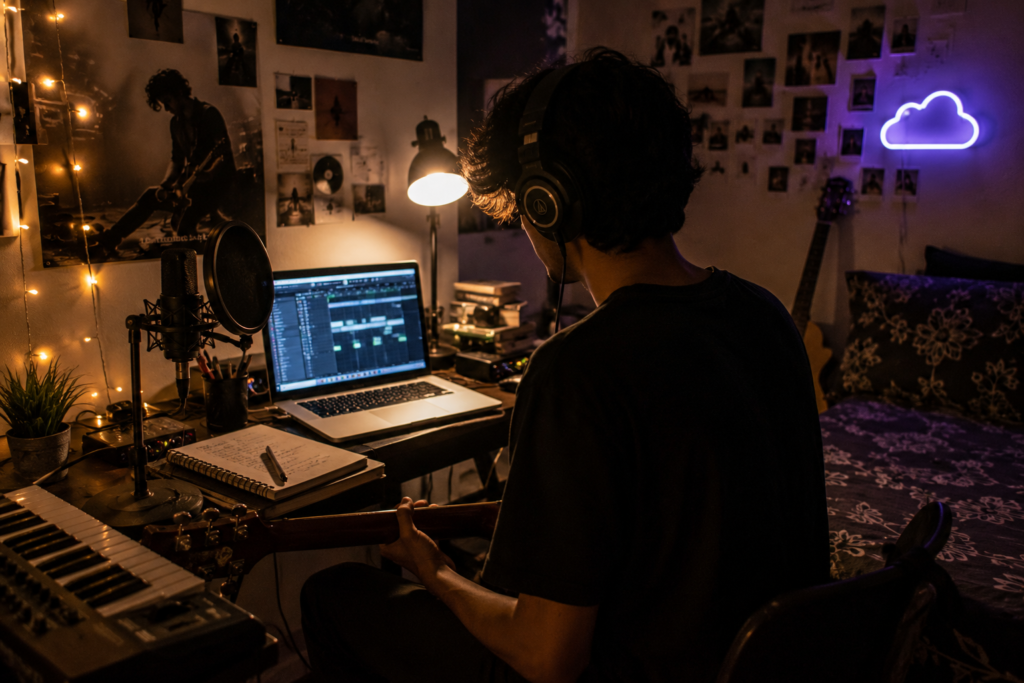
Some of Pakistan’s freshest music does not sound like it came from a giant studio with dramatic lighting and someone saying ‘one more take’ for the hundredth time. It sounds like it came from a bedroom, a laptop, a borrowed mic, and a person who had feelings at 2:47 a.m.
Welcome to the rise of bedroom musicians in Pakistan.
These artists are not waiting for big labels, expensive studios, or television platforms to discover them. They are recording vocals under blankets, producing beats on laptops, uploading songs to streaming platforms, and promoting themselves through Instagram, TikTok, YouTube, and pure emotional damage.
Why Bedroom Music Is Growing
The biggest reason is access. You no longer need a full studio to begin. A basic mic, editing software, internet connection, and a clear creative identity can be enough to start. For young Pakistani artists, this has opened the door to experimentation. They can write in Urdu, English, Punjabi, Pashto, Sindhi, Balochi, or a mixture of everything. They can make lo-fi, pop, rap, R&B, indie rock, acoustic heartbreak songs, or whatever genre best describes ‘I miss someone but I also have an assignment due.’
Social media has also changed discovery. Earlier, artists often needed industry connections. Now, one reel can introduce a song to thousands of people. One relatable lyric can become a caption. One chorus can become a trend.
The Sound of a New Generation
Bedroom music often feels intimate because it is intimate. It does not always chase perfection. Sometimes the vocals are soft, the production is minimal, and the lyrics feel like a message someone was too afraid to send. That rawness is exactly what makes the sound powerful.
Pakistani listeners, especially younger audiences, are responding to music that feels personal. They do not always want dramatic poetry sung from a mountaintop. Sometimes they want a simple line that sounds like their own chat history.
This is why indie and self-made artists are becoming important voices. They are writing about loneliness, ambition, friendship, city life, heartbreak, identity, and confusion in a way that feels current. It is not always polished, but it is honest.
From Bedroom to Big Stage
The bedroom musician does not always stay in the bedroom. Many independent artists now move from online communities to live gigs, collaborations, major playlists, and big platforms. Pakistan’s mainstream music culture has also started making more room for younger, experimental sounds.
Coke Studio’s recent seasons, for example, have shown how traditional sounds, regional languages, rap, pop, and indie voices can sit together. Songs such as ‘Jhol’ and ‘Blockbuster’ proved that Pakistani audiences are open to different textures when the music feels alive.
Why This Matters
The rise of bedroom musicians matters because it makes the music scene more democratic. It means someone from a small city, a university hostel, or a middle-class home can enter the conversation. They may not have industry backing, but they may have a story, a laptop, and enough heartbreak to power three albums.
It also changes what Pakistani music sounds like. The more people create, the more diverse the sound becomes. We get more accents, more languages, more moods, and more stories.
Final Thought
Pakistan’s next big sound may not come from a fancy studio. It may come from a room with fairy lights, bad Wi-Fi, and a singer whispering into a mic because everyone else at home is asleep.
And honestly, that makes it even better.